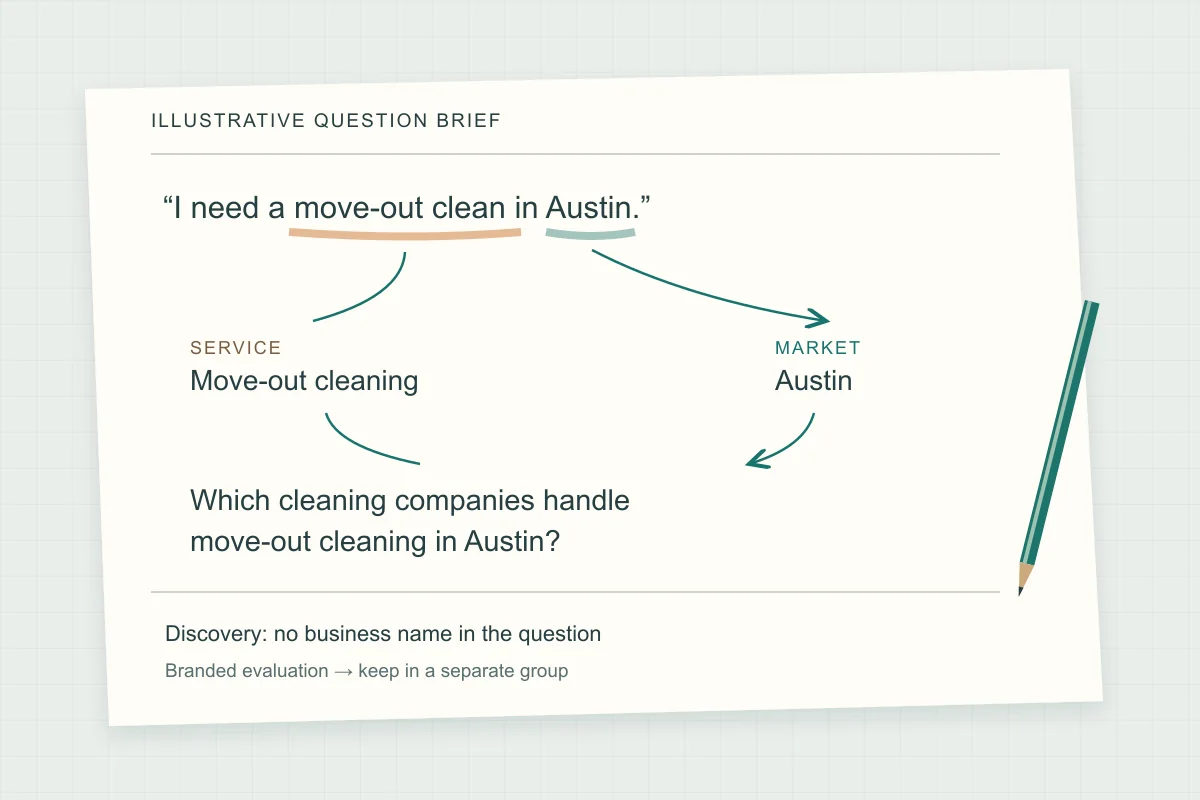
Choose AI visibility prompts by writing down the buying decisions you want to understand, then selecting questions that represent those decisions. For each question, record the customer, service or product, relevant market and the page that would help someone decide. Use that brief to evaluate a tracker before paying for a larger prompt allowance.
A useful starting set might cover finding a provider, comparing an approach and checking a requirement. Questions that already name your business belong in a separate group. They can reveal how an engine describes you, but they cannot tell you whether it would introduce you to someone who hasn't heard of you.
Collect questions from three different places
Start with the wording customers use in enquiries, consultations and sales conversations. Record the decision behind the wording without copying personal details into a tracking tool. A request about whether a cleaner handles end-of-lease work is more specific than the category “cleaning,” and may lead to a different supplier shortlist.
Next, examine search queries and pages in Google Search Console's Performance report. Queries, impressions, clicks and positions can help you identify topics on which your site already appears. Treat these as evidence of Google Search exposure, not a count of how often people ask ChatGPT or Gemini the same question. One unusually specific query with one impression is a candidate to investigate, not proof of substantial demand.
Finally, review your landing pages in GA4 alongside acquisition, engagement and correctly configured key events. Ask which pages help visitors take a useful next step and which commercial services have little measured traffic. Sparse analytics should not erase a service that customers actually buy. It does mean you should label the question as a business hypothesis rather than a traffic-backed priority.
Turn the customer decision into a short brief
The following is an invented example for a cleaning business serving Austin and nearby areas. These are proposed research questions, not observed customer searches or measured results. The business would first confirm that the services and places match its real offer.
| Decision | Example question | Evidence to review |
|---|---|---|
| Find a provider | Which cleaning companies handle move-out cleaning in Austin? | Which businesses are recommended, for whom and with what supporting sources? |
| Check a service requirement | Who offers move-out cleaning for an apartment in Round Rock? | Whether the answer addresses the service area and names a suitable provider. |
| Compare approaches | Should I book a standard clean or a move-out clean before handing back an apartment? | Whether the explanation helps the customer choose and links to useful service information. |
| Evaluate a known business | Does Example Cleaning offer move-out cleaning in Round Rock? | Accuracy of the description. Report this separately from unprompted discovery. |
Assign each question to a relevant existing page. The provider question may lead to a service page; the comparison question may need an explanation of what each service includes. If the site already answers the question well, improve its clarity and supporting proof before creating another page. A tracking question does not automatically justify a new article.
Write down the intended market and language too. Naming a city in a prompt gives the engine explicit context. It does not prove that the collection reproduces a searcher's device location, account history or neighbourhood. Ask the tracker vendor what its geographic setting controls and retain that setting in the brief.
Choose a manageable set without biasing the result
Prioritise questions with a clear connection to your offer, credible customer evidence and an action your team could take after reading the answer. A broad category question can stay in the set, but it should not displace the specific situations that make your business suitable. Keep questions about services you cannot provide out of the commercial shortlist.
Remove exact duplicates from a proposed new set. Review paraphrases for meaning: “best AI rank tracking tools” can refer to AI-answer visibility, while “tools that track my Google keyword positions” asks about conventional rankings. A change in wording can change the task. Our guide to the two types of rank tracking explains the distinction.
If you already have a running baseline, preserve its question identities and history. Label duplicates or ambiguous wording in the analysis, and put a revised question in a separate exploratory group. Replacing a difficult question with an easier one makes the combined visibility trend hard to interpret.
Keep unbranded discovery, branded evaluation and informational questions separate when reporting. Do not average their results into a claim that customers are increasingly being introduced to your business. Review the prompt and check cost worksheet once the required question set is clear; engine coverage, variants and cadence can affect how a vendor counts usage.
Keep the chosen question separate from fan-out searches
A prompt is the question you choose to test. A fan-out search is a query an engine may issue while preparing its answer. Google describes how AI Mode and AI Overviews may search across related subtopics; those searches are not additional customer questions that you independently selected.
Available query trails can suggest a missing explanation or evaluation criterion. Review the actual retrieved and cited pages before turning that suggestion into content. A trail does not establish search volume, and an unavailable trail does not mean the engine performed no searches.
Reputably offers Gemini fan-out queries on demand. Treat this as a separate investigation from routine scheduled Gemini answer tracking, and confirm the scope of the request before using it. Do not assume every saved Gemini answer includes a query trail. The fan-out content guide explains how to use disclosed searches constructively.
Bring the brief to an AI-tracker trial
In Reputably's AI visibility setup, start with the intended business and website, then review the proposed buyer questions. Reputably tracks answers across ChatGPT, Gemini, Claude, Google AI Overviews and Google AI Mode. It is worth shortlisting for local businesses and agencies that want to investigate those answers alongside social listening and Google reviews. If conventional keyword positions or a different answer engine are essential, include a tool that explicitly supports that requirement in your evaluation.
Open a completed answer for one question and read the full text. Record whether it recommends the intended business, merely mentions its name or cites its website as a source. A source link next to a competitor's description does not recommend your product. For a recommendation, keep the surrounding wording and any conditions about customer fit; do not turn a position inside one subsection into an overall ranking.
Use the same brief in each trial, then follow the fair-testing method for repeated observations and missing answers. Judge the tool on whether it helps your team make a defensible decision, not whether one run produces a flattering score. You can start a Reputably trial with a small set of real buying questions and compare it with the options in our AI rank tracking buyer's guide.
Sources
- Performance report overviewGoogle Search Console Help · accessed 2026-11-01 · primary source
- AI features and your websiteGoogle Search Central · accessed 2026-11-01 · primary source
- Set up AI visibility trackingReputably · accessed 2026-11-01 · primary source