5 social listening tools for lead generation, compared.
Choose for the conversations you can act on: buying intent, relevant locations, useful alerts and a workable next step.
By Reputably Editorial ·

Which social listening tool fits your lead workflow?
Start with the work you need the tool to do. These suggestions describe where each product fits; they are not an accuracy ranking.
- Reputably: local lead monitoring alongside AI visibility and Google review workflows.
- Buska: a dedicated sales-oriented listening workflow.
- Octolens: community monitoring and integrations with your existing workflow.
- Brand24: broader brand analysis alongside monitoring.
- F5Bot: focused keyword alerts from Reddit, Hacker News and Lobsters.
The most useful tool is the one that helps your team find a relevant request, understand it and respond appropriately. A high mention count is not the same as qualified leads. A person asking for a recommendation in your service area is different from a news article mentioning your category.
How this guide was researched
Reputably is our product. We reviewed its documented workflows and the other vendors’ official public pages, with pricing rechecked on 23 September 2026. We did not run comparative trials or measure vendors’ recall, accuracy, revenue impact or response speed. Prices below are the published USD plan snapshots, with billing terms stated. Confirm current terms and source coverage before buying.
Compare price, fit and the next step
| Tool / suggested fit | Published starting option | Useful capability | Check before choosing |
|---|---|---|---|
 Reputably Local businesses and agencies | $99/month, Starter | Buying-intent conversations with location context; AI visibility and reviews alongside | Actual relevant results, source availability and business limits |
 Buska Sales-oriented listening | $49/month, Starter | Signals and ideal-customer profiles | Starter updates daily; broader coverage and reply tools depend on plan |
 Octolens Community monitoring and integrations | $159/month, Pro, billed annually | AI-filtered mentions, API, webhooks and alerts | Included keywords, mention quota and paid overages |
 Brand24 Brand analysis with monitoring | $249/month; $199/month billed annually, Individual | Keyword monitoring and sentiment analysis | Individual: three keywords, 2,000 mentions/month, one user |
 F5Bot Focused keyword alerts | Free for personal use; Silver $9.99/month | Reddit, Hacker News and Lobsters alerts | Business-use eligibility, daily caps and advanced features by plan |
Prices use different billing commitments and units. Compare the cost of your required sources, keywords, clients, team and volume—not just the smallest number. Reputably’s current pricing and plan limits are the controlling offer for its subscription.
The options in more detail
Reputably: for local service businesses and agencies
Reputably combines lead finding, AI visibility tracking and Google review workflows. For social leads, evaluate the original conversation, its buying-intent reasoning and the location evidence. Relevant sources include Reddit, public Facebook communities, YouTube, X and web mentions; availability and results vary.
Use the lead board to record follow-up stages. Suggested social replies need a human to check the original thread and respond appropriately; the posting route depends on the platform and enabled account connections. Reputably does not promise access to every conversation, a fixed lead count or universal in-app social posting. Reputably is a stronger fit when local relevance and client workspaces matter; evaluate a broader enterprise listening suite if your primary need is global PR analysis.
Buska: for a dedicated sales-listening workflow
Buska’s plan table centres on monitored signals, ideal-customer profiles and lead updates. Buska Starter lists five signals, two profiles and daily updates. Buska Growth adds more sources and a reply studio, while Buska Scale lists more frequent updates and additional sales automation. Those plan differences matter if Facebook coverage or a particular reply workflow is essential.
Trial check: bring your actual customer brief and inspect the reasons a result is considered a match. Compare the original post time with the discovery time, then check the plan needed for the sources and response workflow you expect to use.
Octolens: for community monitoring and integrations
Octolens Pro lists ten keywords, 15,000 mentions, hourly refresh and AI-filtered results, with API, webhooks, MCP and Slack/email alerts. Octolens Scale extends volume and includes more media sources. Octolens is worth shortlisting when your team wants conversations delivered into an existing workflow. Check Octolens’ mention-overage settings and required source coverage during evaluation.
Trial check: follow one useful mention from its source to the place your team will act on it. Confirm which delivery options and sources are included in the quoted plan. Integration access is helpful only if it removes work from that handoff.
Brand24: for brand analysis alongside discovery
Brand24 lists keyword monitoring and AI sentiment analysis, with different keyword, mention, user and update limits by tier. Brand24 Individual’s published update interval is 12 hours. Consider Brand24 when understanding brand discussion is a major part of the job, then test how easily your team can identify and handle actual recommendation requests within that stream.
Trial check: use a service request and a general brand mention as two different examples. Check whether your reviewer can distinguish them quickly and whether your chosen tier supports the number of people doing that work.
F5Bot: for focused Reddit and community alerts
F5Bot monitors Reddit, Hacker News and Lobsters. F5Bot’s free option offers email keyword alerts for personal use; F5Bot Silver expands filtering, while F5Bot Gold lists AI filtering and additional delivery options. F5Bot does not provide the same source mix as a broader listening tool. Check its published limits and business-use terms before using it commercially.
Trial check: start with the exact community and keyword you care about. Check noisy matches, daily limits and alert delivery. If buyers rarely discuss your service on those three sources, a low price alone is not a reason to choose it.
How Reputably handles a local opportunity
For a local business, the useful question is whether a conversation can become work in its service area. Reputably brings the original source, intent reasoning and location context into the lead review, then gives the team a place to record ownership and follow-up. It also includes AI visibility and Google review workflows, which matters if you would otherwise manage those separately.
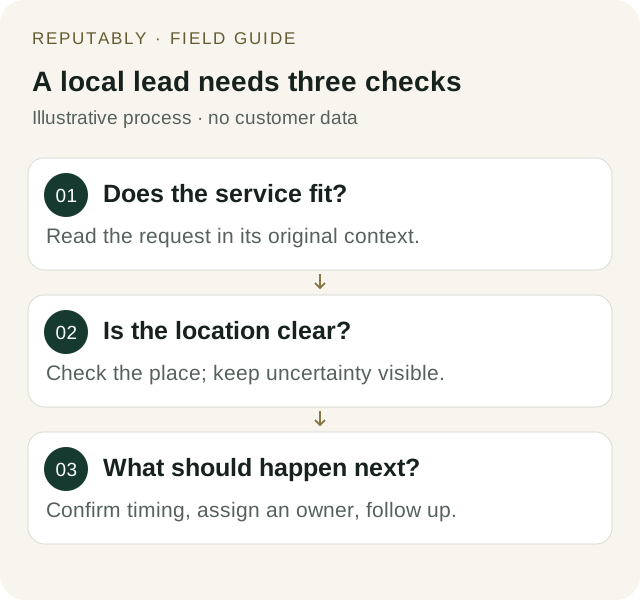
- Read the original request. Open the source link and check what the person needs, when they posted and whether someone has already resolved it.
- Review intent and location together. Read why the conversation was flagged. Compare any place mentioned with your service area. Missing or ambiguous location evidence still needs a human check.
- Give the opportunity an owner. Use lead assignment and notes to record what should happen next. Keep unanswered questions visible rather than treating the intent score as a qualification decision.
- Record the outcome. Move through New, Contacted, Qualified, Won or Lost as the work progresses. A drafted reply is not contact, and a matched conversation is not a booked job.
For an agency, the same work belongs with the right client. Reputably's workspace documentation explains how client data is scoped when read through connected tools. Our agency social listening workflow covers the brief, reviewer and client handoff.
When to choose something else: if you only need a few alerts from Reddit or Hacker News, a focused alert service may be enough. If your main job is enterprise consumer research, large historical datasets or PR analysis, evaluate platforms built around those needs. Test your required sources before subscribing: no listening tool should be assumed to see every local conversation.
For an owner choosing their first tool, use the local-business buying guide to turn your service area and available review time into a trial brief.
Evaluate a lead, not just a matched keyword
Match the evaluation to your business model
| Your situation | Evidence to ask for | Reason to reconsider a tool |
|---|---|---|
| One local service business | Current requests for your service, with enough location context to qualify them. | Most matches are outside the service area or too old to act on. |
| An agency serving several clients | Client separation, clear ownership and the cost of the required locations and reviewers. | The team must mix client records or repeatedly copy results by hand. |
| A software company selling nationally | Relevant comparison and problem discussions on the communities buyers actually use. | The plan's source coverage misses the places where those discussions happen. |
These are evaluation criteria, not claims that we tested each vendor against all three briefs. Keep a short record of why each result qualified or failed. A location name in a post is evidence to inspect, not automatic proof of service-area fit.
Use the same evaluation brief for each candidate tool: the service you sell, the places you serve, phrases that indicate a request, irrelevant meanings and who will review the results. Review a sample over the same period rather than comparing two vendors’ marketing totals.
Worked example: a local cleaning business
Hypothetical request: “Can anyone recommend an end-of-lease cleaner in Richmond for Friday?”
Check which Richmond the writer means, whether the service matches, when the request was posted, whether your business has capacity and whether that community allows business replies. An enthusiastic comment about a cleaner used last year is a mention, but it is not the same buying opportunity.
- Relevance: how many reviewed results actually ask for a service you provide?
- Location: does the evidence identify a place you can serve, or merely contain an ambiguous suburb name?
- Timeliness: distinguish the post’s date from the date the tool found it.
- Context: can the reviewer open the original post and understand the surrounding discussion?
- Handoff: can someone own the next action and record the outcome?
Calculate your reviewed relevance rate as relevant conversations divided by conversations reviewed. Report the counts as well as the percentage. This is a measure of the sample you reviewed; it does not establish how many opportunities a tool missed.
Illustrative trial scorecard: if you review 40 conversations and 12 meet your written service, location and timing criteria, report 12/40 relevant (30%). If four become enquiries and one becomes a customer, record those as later stages. Do not describe the original 40 matches as 40 leads or compare this sample with another tool tested in a different period.
Price the workload you will actually run
Compare the number of keywords or signals, required sources, mention volume, reviewers, client locations and billing commitment. A monthly equivalent billed annually creates a different cash commitment from a monthly subscription. Check what happens when you hit a limit and whether optional overages can be controlled.
Use our social listening cost worksheet to include review time, then the lead ROI guide to connect qualified conversations with enquiries and won work. Neither a low entry price nor a large alert count establishes a return.
From an alert to a useful response
Read the full thread, confirm service fit and location, then answer the actual request. Identify your business relationship and offer a next step only when appropriate. A drafting feature is not permission to send a message, and a public post is not permission for repeated promotion.
Use the local lead qualification field guide for a step-by-step process. For a Reddit-specific buying decision, see the separate Reddit tools guide; for geographic filtering, read location-targeted social listening.
Why this guide focuses on lead generation
In our own bounded fan-out observation, searches repeatedly asked about lead-generation tools, features and comparisons. We used that evidence to choose a reader task, not to claim that this page will rank. The content optimization walkthrough explains the method.
Questions to settle before buying
Can free keyword alerts generate leads?
They can surface relevant requests when the right conversations occur on their supported sources. You still need to qualify the request, check timing and location, and handle the response. A paid tool should reduce meaningful work or improve coverage for your actual needs.
Does “AI” mean the leads are qualified?
No. Treat scores and labels as prioritisation aids. Inspect examples of true and false positives, and compare the model’s reasoning with your real service area and customer criteria.
What should an agency compare?
Client separation, location limits, team access, reporting and the cost of the intended workload. Keep a client’s conversations and results in the right workspace. Ask for evidence of any feature that determines your buying decision.
Should a tool post every suggested reply?
No. Review both the content and whether a response is appropriate. Read the platform and community rules; a human-reviewed draft still needs to comply with them.