
Choose a social listening tool that helps you verify the service, place and timing of a request. A busy feed is worth little to a plumber if most conversations come from places they don't cover. Before comparing features, write down the jobs you want, your service area and who will follow up.
Reputably is worth shortlisting when you want local lead monitoring alongside review management and AI visibility. A focused alert service may be enough if your customers use a small number of communities. Broader listening platforms make more sense when brand research and marketing analysis are also part of the job.
This is a buying guide from Reputably Editorial. Reputably is our product; the alternatives below are based on official vendor pages checked on 23 September 2026, not a head-to-head performance test. For a full price comparison, see our social listening tools for lead generation guide.
Start with the conversation you need to find
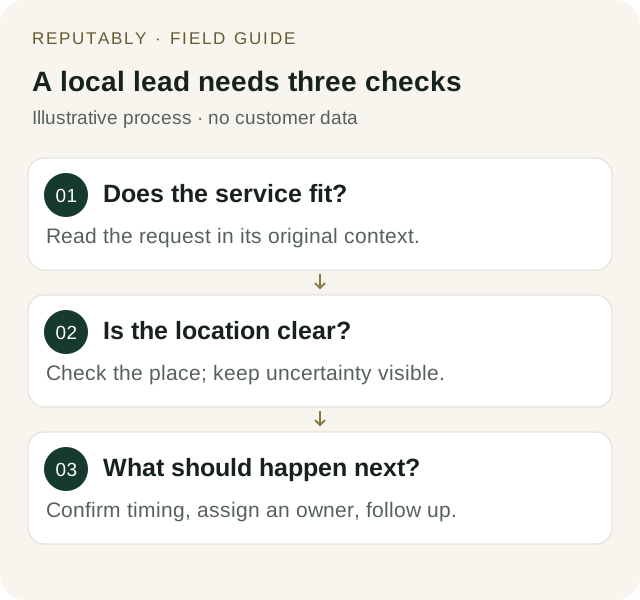
Imagine you run a cleaning business covering Richmond and nearby suburbs in Melbourne. “Can anyone recommend an end-of-lease cleaner in Richmond for Friday?” looks promising. “Best cleaner in Richmond?” is less clear: it could refer to another city, a cleaning product or a request that has already been resolved.
These are invented examples, but they make a useful trial brief. You want to see the original post, its date, the surrounding discussion and whatever location evidence exists. A location label should help you investigate. It shouldn't hide uncertainty.
Shortlist tools by the work you need done
| Option | Consider it when | Check in your trial |
|---|---|---|
 Reputably Reputably | You want intent and location context, lead follow-up stages, reviews and AI visibility in one service. | Whether the available conversations match your services and locations; whether the included business limits suit you. |
 Buska Buska | You want a sales-oriented listening workflow with signals and ideal-customer profiles. | Which plan includes your sources and how often it updates them. |
 Octolens Octolens | Your audience uses its supported communities and you want alerts or data in an existing workflow. | Source fit, keyword and mention allowances, and whether the integration reduces manual work. |
 Brand24 Brand24 | You also need to understand brand discussion and sentiment. | How much review time it takes to separate potential jobs from general conversation. |
 F5Bot F5Bot | Reddit, Hacker News and Lobsters cover the conversations you need. | Commercial-use terms, filtering, daily caps and whether those sources are enough. |
The vendors package these features differently. Buska's plan table lists daily updates on Starter and adds Facebook among the sources on Growth. Octolens Pro lists hourly refresh, AI filtering, API access and webhooks. Neither detail proves that a particular neighbourhood's conversations will be available.
Brand24's Individual plan lists three keywords, 2,000 monthly mentions and one user; higher tiers change the workload it can support. F5Bot's tiers separate personal-use free access from paid options and vary the filtering and delivery features. Check the current offer for your intended use instead of assuming “free” or “all platforms” means everything you need.
What to inspect in Reputably
For a potential lead, open the source conversation and read the buying-intent reasoning. Then compare the location evidence with your actual service area. “No location signal” should lead to a closer look, not an assumption that the person is nearby. An out-of-area request can still be useful market research without belonging in your sales queue.
The lead workflow supports an owner, notes and follow-up stages such as New, Contacted, Qualified, Won and Lost. Agree on what those stages mean in your business. A suggested reply is still a draft to review; the available posting route depends on the platform and enabled account connections. It doesn't grant permission to promote your business in a community.
Use local lead monitoring for the product overview and location-targeted listening for the geographic approach. If you already have a tool and need an operating routine, our local listening field guide covers finding and handling requests.
Run a trial that answers a buying question
Test two shortlisted tools over the same period with the same service brief. Review the original conversations rather than comparing the headline number of matches. Keep a short note for each result: relevant, wrong service, outside area, unclear location, too old or duplicate.
Track the time spent reviewing as well. A tool that finds more useful requests but takes hours to sort may be a poor fit for an owner handling calls between jobs. Equally, a quiet week doesn't establish that the tool never finds anything: demand and available source coverage vary.
Before paying, answer three questions with actual examples: did it find requests you could reasonably serve, did it make qualification easier, and did someone take the next step? Use the cost worksheet to include your time, then the lead ROI guide to record enquiries and booked work separately.
When to keep looking
Keep looking if the trial depends on a source the vendor cannot demonstrate, if vague location matches dominate the feed, or if nobody has time to respond. No amount of automated scoring fixes a business that cannot take the job.
For several client businesses, the buying decision changes again. You need clear ownership and client separation as well as relevant conversations. Our agency social listening workflow shows how to organise that handoff.
Sources
- Buska plans and source coverageBuska · accessed 2026-09-23 · primary source
- Octolens pricing and integrationsOctolens · accessed 2026-09-23 · primary source
- Brand24 pricing and plan limitsBrand24 · accessed 2026-09-23 · primary source
- F5Bot account tiersF5Bot · accessed 2026-09-23 · primary source