
An agency's social listening workflow needs a named person to handle each useful conversation. Finding a recommendation request is a start. The client still needs to know why it fits, where it came from, who should respond and how to record the outcome.
Use a separate client workspace, qualify the request, assign the next action and report what actually happened. That keeps the service understandable to clients and gives your team a repeatable way to work. The routine below is a suggested process; it isn't a claim that any software automatically performs every step.
Agree on what the client wants to find
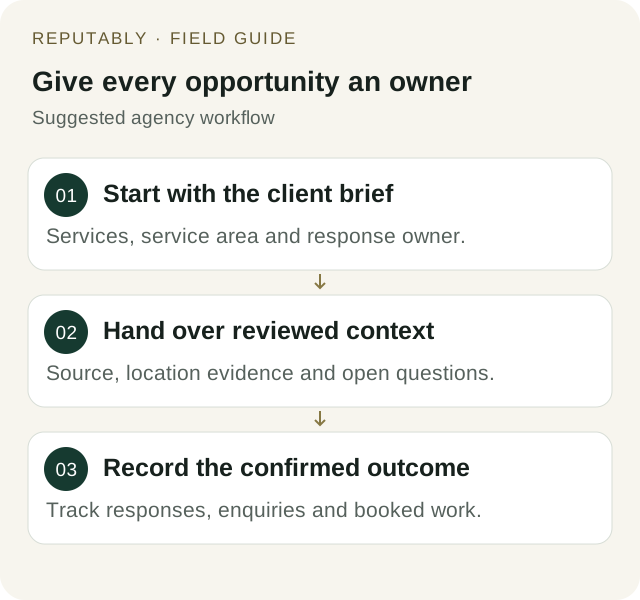
Start with a short brief. List the services the client can sell, the places they serve, exclusions, current capacity and the person who will handle enquiries. A cleaner who wants regular office contracts needs a different feed from one looking for residential move-out jobs.
Agree on response boundaries at the same time. Can your team reply on the client's behalf, or must the owner approve each response? Who confirms prices and availability? Don't let a drafted answer make a promise nobody at the business has approved.
This brief also tells you what to buy. A client asking for new local enquiries has different needs from a communications team researching brand sentiment. Use the lead-generation tool comparison to shortlist the right category before choosing a plan.
Keep each client's work together
In Reputably, agencies can organise clients into workspaces. Keep the right business, tracking setup and results together, and confirm the client name before inspecting or sharing a lead. The public workspace documentation explains the same boundary for connected assistants: each read targets a particular workspace. An empty default workspace doesn't prove that a client's workspace has no results.
For an agency using an assistant to prepare summaries, name the client workspace explicitly. Check the returned business and date range before drawing a conclusion. This small habit prevents an apparently tidy report from describing the wrong client or an empty workspace.
Send a useful handoff, not a pile of alerts
Open the original conversation before forwarding it. Check the service, location and timing, and read the surrounding discussion. Reputably's intent reasoning and location context help with that review; the score itself is not proof of a qualified lead.
| Include | Why it matters |
|---|---|
| Original conversation and post date | The responder can check context and whether the request is still open. |
| Service and location evidence | The client can judge whether they can take the job. |
| Anything still unknown | An ambiguous suburb, budget or deadline remains a question to resolve. |
| Owner and next action | Someone knows they are responsible for reviewing, replying or declining. |
| Draft, if useful | The client has a starting point to edit, with no invented price or availability. |
For example, an invented handoff might read: “Move-out cleaning request in Richmond, posted today. Melbourne appears likely from the thread, but confirm it. Friday availability is unconfirmed. Mia to review and respond if the job fits.” That is more useful than “92% intent—please contact”. It explains the decision and the missing information.
Reputably's lead workflow includes assignment, notes and stages. Use those fields to keep follow-up attached to the opportunity. Agree separately on a response window and how the client will send updates; don't assume that assigning a lead guarantees a notification or an automatic reminder.
Make stages mean the same thing to everyone
Define the stages before your first client report. A suggested convention is: New means awaiting review; Contacted means someone actually responded; Qualified means the client's agreed criteria are met; Won means the client confirms booked work; and Lost means the opportunity did not proceed. Keep a note of why it was lost when you know.
The software can record a stage, but the team needs to supply the evidence. A public reply is not necessarily an enquiry. A promising conversation is not a booked job. Leave the outcome unknown when the client hasn't confirmed it.
Review replies before they leave the team
A useful reply answers the person's question, identifies the business relationship and suggests a next step only when appropriate. Check the community rules first. Reddit's spam guidance, for example, makes repetitive or unsolicited activity a concern; having a relevant keyword in the post doesn't make promotion welcome.
In-app posting options depend on the platform, enabled features and connected accounts. A copy-and-open workflow may be the appropriate route. If you use an assistant through Reputably's MCP connection, the tool reference distinguishes generating a draft from sending it: its reply tools produce drafts, not external posts.
Report the work and the outcome separately
Show how many conversations were reviewed, how many met the client's criteria, how many received a response and which outcomes the client confirmed. Report time spent as well. This helps explain whether a change in keyword setup improved useful results or simply increased the review workload.
Keep Google reviews and AI visibility as separate parts of the report. They may belong in the same subscription, but an AI citation is not a sales enquiry, and a review reply is not a won lead. The lead ROI guide covers costs and outcomes in more detail.
Start with one client whose service area, capacity and response owner are clear. Review missed handoffs before adding more clients. Reputably's agency overview explains how social listening sits alongside review management and AI visibility; the local tool buying guide helps evaluate the listening work itself.
Sources
- Reputably workspace scopingReputably Documentation · accessed 2026-09-23 · primary source
- Reputably MCP tool referenceReputably Documentation · accessed 2026-09-23 · primary source
- SpamReddit Help · accessed 2026-09-23 · primary source