Qualify a local listening lead against the place where the service is needed. Read the request and its replies for that location, compare it with the areas your business serves, and keep any uncertainty visible before assigning the enquiry. A profile city, group name or country label can help you investigate, but each describes something different.
This is also a useful software buying test. Ask a vendor to show why a result is considered local and whether a reviewer can inspect the underlying conversation. A filter that makes a feed look geographically tidy may still leave the person responding with a question to ask.
Keep the job location separate from other place clues
A person can live in one city and arrange work at a parent's home elsewhere. They can post before moving, ask about a second property, or use a regional group to find someone serving a nearby suburb. The place attached to the author does not settle where the job will happen.
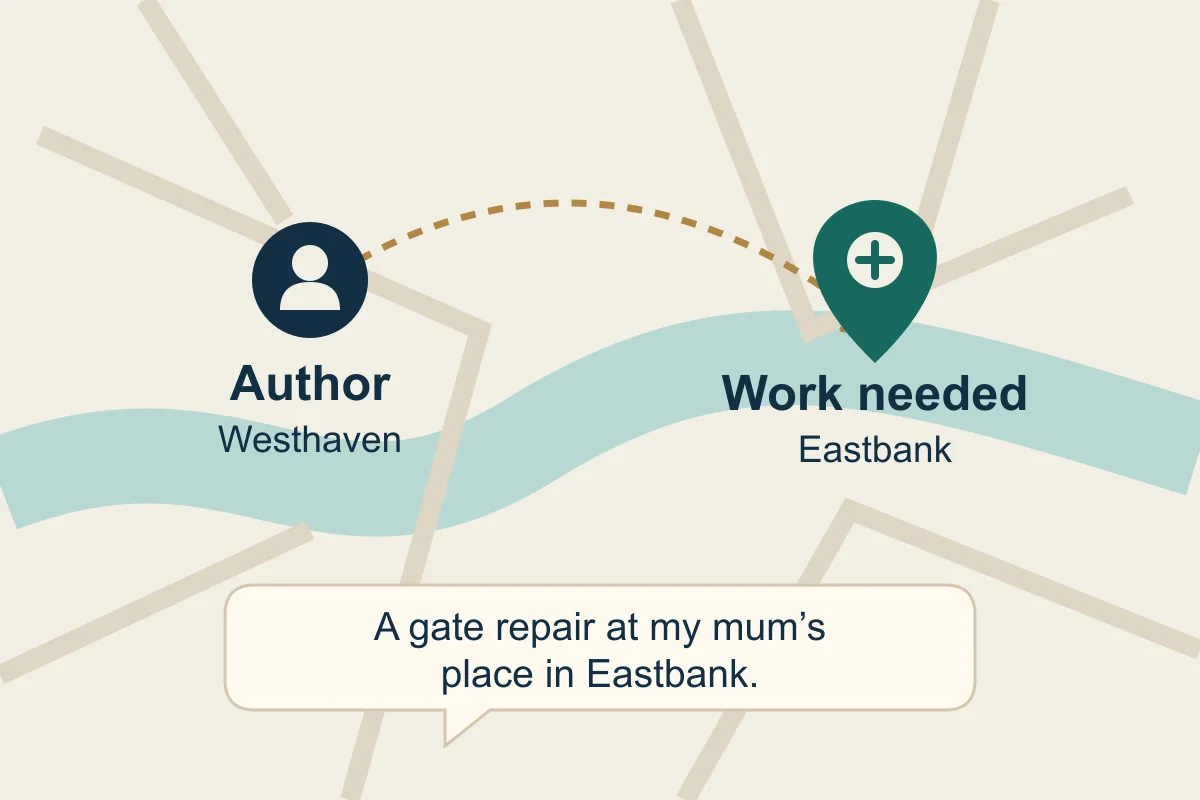
For an invented example, imagine an author whose profile says Westhaven asking: “Can anyone recommend someone to repair a gate at my mum's place in Eastbank?” The explicit service location is Eastbank. Westhaven remains context about the author. A Westhaven business should check whether it serves Eastbank before treating the request as local.
Keep three short notes when they differ: the place stated in the request, the context that supports that interpretation, and what still needs confirming. If the source only gives a broad region, preserve that level of detail. Do not turn a city-level clue into a confirmed address.
Use different next steps for different evidence
| What the request says | What you know | Next step |
|---|---|---|
| “Need a gate repaired in Eastbank.” | The author explicitly names the work location. | Compare Eastbank with your service area and check the job itself fits. |
| “Anyone know a good cleaner?” in a regional group | The group provides a clue, but the work location is unstated. | Ask which suburb the cleaning is for before promising availability. |
| “Moving to Eastbank next month. Need an electrician.” | The intended location and future timing are relevant. | Review coverage for the destination and keep the date with the request. |
| “Looking for a bookkeeper who works remotely.” | Physical distance may be less important than the service requirements. | Check the business's remote-service scope rather than applying an on-site travel rule. |
A result with no stated location should remain available for clarification when your process supports that. An unknown place and an explicitly out-of-area job deserve different labels. Combining them makes it harder to tell whether the feed is producing unsuitable work or requests that simply need one more question.
Ask what the software's location field represents
Location controls vary across products and sources. Brand24's geolocation documentation describes country and continent filtering and notes that some mentions lack specified countries. That can support broad monitoring; it does not establish a street address for a service request.
Mention's documentation describes country-level monitoring, says city and state filters are unsupported, and explains how to retain mentions without country information. It also describes source-specific availability. Read the current documentation for the exact product and plan you are considering rather than treating every “location” feature as equivalent.
When reviewing a demo, ask whether a place comes from the post, an author profile, a publishing source, an inferred interpretation or your chosen monitoring area. Then ask whether that evidence is visible to the person qualifying the job. A useful explanation should make the remaining uncertainty easier to assess.
These are documented capability examples, not a measured ranking of vendors' geographic accuracy. We have not run a comparative location benchmark. Source availability and the context in an individual conversation still affect what your team can establish.
Write a service-area brief that a colleague can use
List the named areas where you normally accept work, along with any important exceptions. A business might cover a city for larger jobs but take small callouts only in selected neighbourhoods. Another may provide remote advice nationally while keeping installation work local. Use the actual operating rule rather than a broad marketing description.
For multi-location teams, identify who reviews requests near a boundary. Keep one owner until the team agrees to transfer it. The agency handoff guide covers ownership and follow-up; the deduplication guide helps when the same conversation reaches more than one team.
Ask for only the detail needed at the current stage. A suburb may be enough to check service fit in a public reply. If more precise information becomes necessary, use the business's normal booking process and an appropriate channel rather than asking someone to post their full address in a discussion.
Include ambiguous places in your trial review
Bring a small set of cleared examples to the trial: an explicit in-area request, a request for someone elsewhere, a move to another city, an ambiguous place name and a post without location information. Include known out-of-area requests as well. Have the person who handles enquiries explain what they would do with each one.
Record which requests can be routed, which need clarification and which are unsuitable. Keep the evidence for those decisions alongside the source links. If a filter removes unknown locations, review what may be lost before deciding that the cleaner-looking feed is better. A small sample checks usability; it cannot prove complete geographic coverage or a general accuracy rate.
Use the coverage test to evaluate whether relevant conversations are collected, and review job fit separately. Finding the right conversation and confirming that your team can serve it are both parts of a useful workflow.
Review local fit in Reputably
Reputably supports named neighbourhoods, cities, states and countries, with location context considered alongside buying intent. Its targeting uses named areas rather than a mileage or kilometre radius. Choose areas that reflect the work your business takes, then inspect the original request before making a commitment.
Start a Reputably trial with a service-area brief and a few examples of requests you would want to review. Keep unresolved places visible in the evaluation. The listening tools comparison helps compare the broader workflow once you know what a useful local opportunity needs to contain.
Sources
- Location-targeted social listeningReputably · accessed 2026-10-29 · primary source
- Geolocation filterBrand24 Help Center · accessed 2026-10-29 · primary source
- Geolocation Monitoring ExplainedMention Help Center · accessed 2026-10-29 · primary source