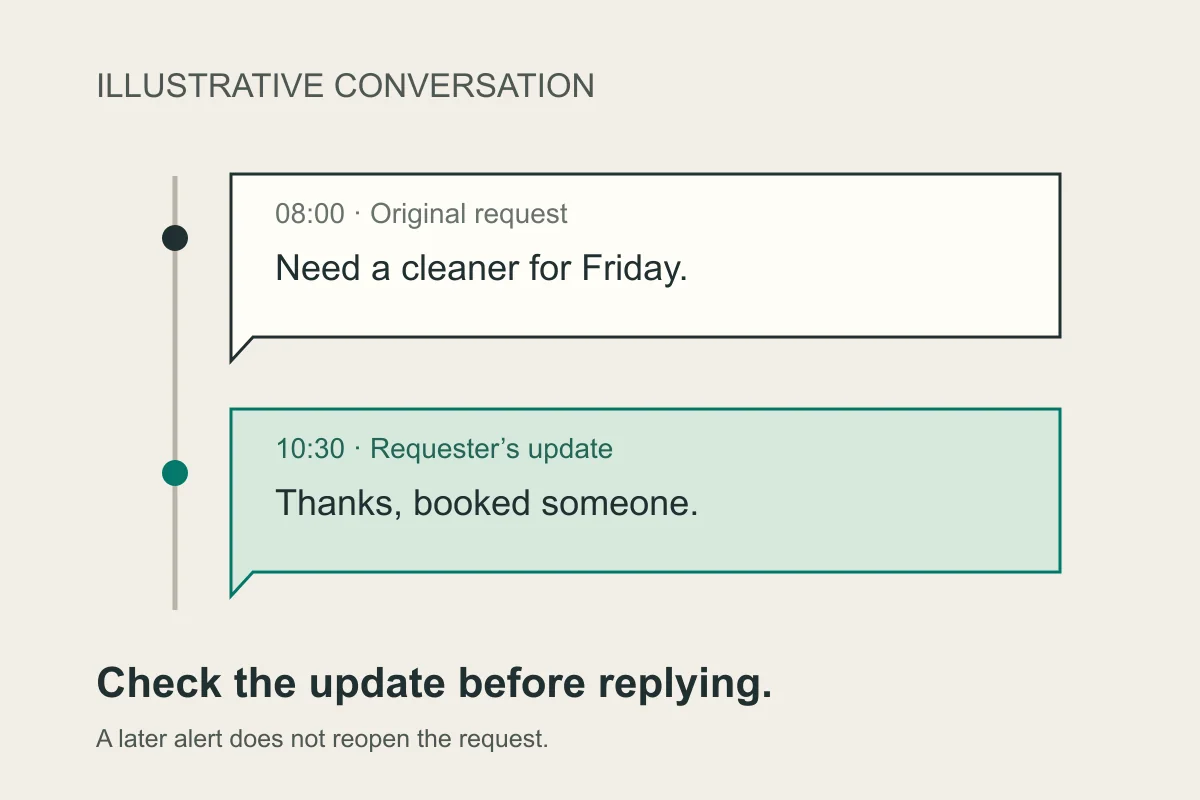
Before replying to a social listening lead, open the original conversation and check the requester's latest update, the job deadline and any replies confirming that someone has been hired. Treat the request as open only when the available evidence supports that decision. If its status is unclear, record what you still need to know instead of treating a new alert as a new buying opportunity.
This matters for local services. A request for a cleaner next month may remain useful for several days, while a request for a repair before tonight may be resolved within the same afternoon. The age of the post is one clue; what the person has said since posting is often the more useful one.
Read the current conversation, including the follow-up
An alert helps you find a conversation. Before acting, read the original post, visible edits and replies from the person who asked. Check whether they changed the location, brought the deadline forward, found someone or decided to postpone the work. A comment from another participant recommending a supplier does not establish that the requester booked that supplier.
Hootsuite's lead-generation guide discusses urgency, context and moving a signal into a sales workflow. For a service business, add a specific check between discovery and response: does this person still need the work you can provide? A high-intent phrase in the original post can remain visible after the buying decision is over.
Consider this invented example. At 08:00, someone asks for a move-out cleaner for Friday. At 10:30, they add, “Thanks, booked someone.” At 11:00, your team receives an alert containing the original request. The sensible action is to record that the job is filled and stop pursuing it. The alert delivery time does not change the requester's update.
Separate evidence of closure from missing information
Use a small set of review labels in your team's worksheet. The following labels describe a suggested process, not built-in Reputably stages or an automated status detector.
| What you can see | Working assessment | Next step |
|---|---|---|
| The requester says they are still comparing quotes for next month. | Appears open at review time. | Check service area and availability, then respond if the rules and question allow it. |
| The requester says, “Booked someone, thank you.” | Resolved for this job. | Record the update and stop the sales follow-up. |
| Another member tags a business; the requester has not replied. | Outcome unknown. | Do not infer either a booking or an invitation to send private messages. |
| The stated deadline has passed, with no visible update. | Original timing has expired; outcome unknown. | Avoid promising the original job. Clarify only if a helpful, permitted response is still appropriate. |
| The original post is deleted or no longer accessible. | Cannot verify current status. | Do not reconstruct a sales approach from an old excerpt or seek private access. |
| The requester says the job is postponed until next season. | Deferred, with no present booking request. | Record the change. Arrange later contact only if the person welcomes it. |
A locked thread or missing comment is an access constraint, not proof that the job was won or lost. Likewise, silence is not a rejection, a booking or consent to repeated contact. Keeping an explicit unknown state makes your workload and reporting more honest.
Check the deadline against the work you can offer
Translate relative wording carefully. “Tomorrow morning” refers to the post's date and the requester's context, not the time your alert arrived. If the platform shows only an approximate age, keep that uncertainty in your note. Do not invent an exact timestamp or timezone to make the record look complete.
Then check your own capacity. An open request in the right suburb is still unsuitable if you cannot provide the required service in time. Confirm availability before a reply mentions a visit, quote deadline or appointment. The service-location guide helps resolve ambiguous place names; the alert-frequency guide covers collection and staffing intervals.
For longer projects, avoid a universal expiry rule. A week-old request for a renovation estimate may still be active if the requester is inviting quotes. A two-hour-old emergency request may already be closed. Use the conversation and stated deadline to decide, then note when you made the assessment.
Leave a short note the next responder can use
Record the original URL, your review time, the latest relevant statement from the requester, the working assessment and the next owner. Keep only the context needed for the job; do not copy an entire personal discussion into a shared sales report.
An invented review note could read: “Checked Wednesday 10:15 local time. Requester still wants office-cleaning quotes for next month; no supplier selected in visible replies. Service area fits. Alex to confirm capacity before replying.” A closed record might say: “Requester confirmed booking another supplier at 10:30. No further sales reply.”
If a handoff waits until the next day, the responder should check the thread again. A previous colleague's assessment describes what was visible then; it is not a promise that the request remains open. Agree who owns that final check in your agency or team handoff.
Use Reputably to prepare the review
Reputably is worth shortlisting for local service teams and agencies that want buying-intent review, location context and lead follow-up alongside AI visibility and Google reviews. Its lead-finding workflow helps bring relevant conversations and suggested replies into a review process. Your team still checks the current thread, decides whether it can help and reviews what will be said.
Collection follows a configured schedule, and availability differs by source. The source limitations matter when a conversation changes or becomes inaccessible. This worksheet does not assume that Reputably continuously rereads every thread or automatically detects a completed booking.
During a trial, take a small sample of relevant requests and walk through this check. Can the reviewer reach the original conversation, understand the intent and location, resolve the current status and prepare a suitable next step without rebuilding the context? Record the review time and unresolved items. That is a useful workflow test; it is not a claim about a vendor's measured accuracy or guaranteed lead volume.
Respond only when the next step is welcome
When a request appears open and your business can help, answer the actual question and disclose your connection to the business. Check community rules before offering services. A public request does not automatically invite an unsolicited private message. Reputably's reply guidelines provide a starting point for reviewing a draft.
If the person has already resolved the request, close your review without another pitch. If the outcome is unclear, keep it uncertain rather than marking it won or lost. Track confirmed enquiries and booked work separately in your lead outcome record.
Bring one typical service request to your next tool evaluation and ask to follow it from discovery through the final pre-reply check. Compare the listening tools and their intended buyers, then explore Reputably's lead workflow against the work your team actually needs to do.
Sources
- Lead findingReputably · accessed 2026-11-04 · primary source
- Safe reply guidelinesReputably · accessed 2026-11-04 · primary source
- Data sources and limitationsReputably · accessed 2026-11-04 · primary source
- How to use social listening for lead generationHootsuite · accessed 2026-11-04 · primary source