Use AI fan-out queries to identify the questions your pages need to answer, then check whether those pages are actually surfaced and cited. A query is a research clue. It is not a ranking instruction, an estimate of search demand or proof that publishing a matching headline will earn a recommendation.
For example, Reputably’s seven-day observation recorded 69 disclosed searches across 33 of 160 answers. “Best social listening tools for lead generation 2026” occurred nine times. That suggests a useful buying guide to investigate. It does not tell us how many people search for that phrase outside the tracker.
Keep the original question, searches and citations together
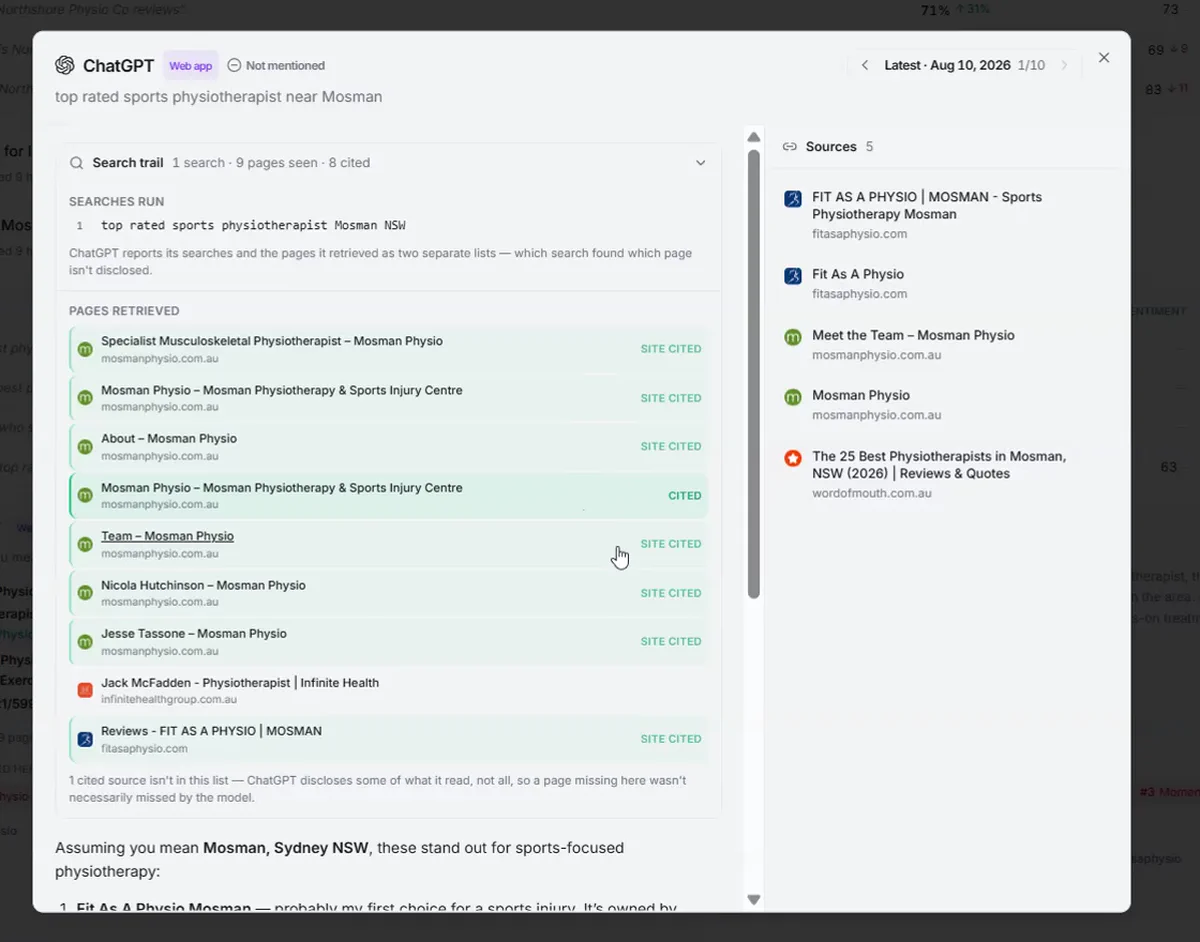
Begin with one original buyer question. Keep the exact wording used for each answer, the engine, provider, collection time, disclosed searches and final cited URLs. Keep these records in your private analysis workspace. Each record represents one answer; queries and final citations sit inside it.
| Signal | What it tells you | How to use it |
|---|---|---|
| Search query | The disclosed wording the engine searched | Understand the subtopic and the kind of evidence it sought |
| Surfaced page | A returned search hit or separately reported browsed page | Review what competing pages explain |
| Final citation | A URL recorded in the answer’s citation list | Find pages used as supporting sources |
Some providers link a search to its hits; others return flat page lists. Preserve that difference. A final citation belongs to the answer unless the provider supplies a more specific relationship. Do not manufacture a query-to-citation path.
Group searches by the buyer’s task
Group “best social listening software for lead generation,” “lead capture features comparison” and “tools for finding new leads” into one buying decision. A single useful comparison can answer all three. Keep a practical setup tutorial separate because the reader is trying to operate a workflow rather than choose a tool.
Watch for ambiguous language. “AI rank tracking” may mean traditional Google keyword positions with AI features, or whether an AI assistant names a brand. Reputably’s AI visibility tracking addresses the latter. Explain that boundary rather than promising conventional keyword-position tracking to catch a broader phrase.
Choose an existing page before opening a new draft
- Find the closest page. Does it already answer this buying decision?
- Inspect recurring cited sources. Note their comparison criteria, examples, evidence and unanswered questions. Do not treat their claims as independently verified.
- Name one useful improvement. For lead-generation software, that might be a comparison of qualification, service-area relevance and what happens after an alert.
- Add a reason to trust it. Include original examples, dated documentation checks, visible limitations and a clear explanation of the method.
- Connect the next step. Link a comparison to the relevant product workflow, and link the product page back to the guide.
For Reputably, that becomes a lead-generation comparison supported by a practical qualification guide. Our existing AI visibility comparison serves a separate buying decision.
Give the reader an answer they can use
A strong comparison says who each option fits, which constraints matter, what pricing unit is being compared and what remains unverified. A strong tutorial works through a real task. A research article explains its method, scope and limitations, and shares findings without exposing private records.
Google recommends helpful content with original value and demonstrated experience. Its AI features guidance also stresses indexability, internal links and readable text. There is no special AI schema requirement that substitutes for those basics.
Measure the sequence after publication
Record the changed URL, change date, buyer task and expected effect. Keep the original tracked questions as a baseline. Add new exploratory questions separately so broader coverage cannot be mistaken for improvement on the original set.
- Availability: the correct page is live, internally linked and available for indexing.
- Discovery: the page gains search impressions or appears in disclosed retrieval evidence.
- Use: its URL is cited, or the brand is mentioned or recommended. Count these separately.
- Business outcome: relevant visits continue to a trial or another meaningful action.
Compare like-for-like engines, providers and wording over several observations. Record missing answers and missing disclosure separately. Do not assign a lift to the edit just because one later answer changed: provider behaviour, web content and the surrounding competitive set can also change.
Use external sources as a second workstream
A search restricted to a competitor’s domain cannot return your own website. Treat that as evidence about the engine’s source selection. Maintain accurate product documentation and identify relevant independent publications where your product genuinely belongs. Any outreach should contribute evidence or correct facts, not buy a claim of independent superiority.
The repeatable routine is simple: inspect the searches, choose one meaningful gap, improve the page, and compare subsequent evidence. Our seven-day study shows both the opportunity and the limits of this method.
Sources
- AI features and your websiteGoogle Search Central · accessed 2026-09-16 · primary source
- Creating helpful, reliable, people-first contentGoogle Search Central · accessed 2026-09-16 · primary source